

Gothic Rapes Imperium Press
Go subscribe to him

Written in response to: The Worst Argument Against Paganism by a more traditional esotericist.
From the perspective of René Guénon and Julius Evola, authentic representatives of the Traditionalist school, the essay you have presented is not merely erroneous but represents a profound inversion of the very principles of Tradition. It attempts to defend a reconstructed paganism by reducing Tradition to a crude imperative ethics, while simultaneously accusing Guénon and Evola of subjectivism and anti authoritarianism. This is a complete misrepresentation that collapses under even shit tier level scrutiny. What follows is a systematic refutation of the essay’s core claims, grounded rigorously in the thought of Guénon and Evola themselves.
The essay quotes Guénon and Evola on the necessity of an uninterrupted initiatic chain (silsila) and then concludes that this requirement makes legitimacy depend on “obedience” and therefore on the subject. This is a categorical error of the highest order.
Guénon and Evola do not argue that authority derives from obedience. They argue the exact opposite retard; authentic initiatic transmission is the sole vehicle by which a supra human spiritual influence can be conveyed to the human domain. The chain is not a historical tally of obedient practitioners; it is the objective channel through which a non human, transcendent influence operates Successively. Guénon is explicit in Initiation and Spiritual Realization and The Reign of Quantity I quote:
“The transmission of the spiritual influence is essentially independent of any moral or sentimental considerations; it is a matter of pure ‘technique’… the chain is the means by which the influence is transmitted, and without this means the influence cannot reach the individual.”
The efficacy of initiation does not depend on the subjective recognition or voluntary assent of the recipient. It depends on the objective regularity of the transmission. The chain guarantees that the influence has not been interrupted or deviated by human invention. To break the chain is not to “disobey a command”; it is to sever the conduit through which the transcendent influence flows. There’s no logic, or emotion, or any lower dogshit claim here, nothing cares when your resist truth, you are merely severed from it. Once severed, no amount of personal enthusiasm, scholarly retard pagan reconstruction, or “renewed obedience” can restore it, because the influence itself is no longer present.
Evola, in works such as Revolt Against the Modern World and The Hermetic Tradition, makes the same distinction between objective spiritual virility and your retarded subjective fantasy. He repeatedly warns against “psychological” or self generated spirituality, which is precisely what a reconstructed paganism without regular transmission becomes.
The essay’s claim that continuity makes authority “flow upward from practitioners” is therefore backwards. Continuity is the proof that authority has remained heteronomous, coming from a supreme center this above, not ratified or articulated from below.
The dogshit essay’s central move is to define Tradition as “a set of practices” that reduce to “commands,” and then to assert that commands remain binding regardless of whether anyone has obeyed them for centuries. This is a modernist reduction that Guénon and Evola would reject outright.
Substack notes won’t let me reply more but I’d rape your dogshit article to death midwit. In fact I will….
To reduce Tradition to a floating set of imperatives that survive historical rupture is to strip it of its ontological grounding. A command without an objective link to its transcendent source becomes mere human preference. This is exactly the subjectivism the essay accuses Traditionalists of introducing.
Evola is even more severe. In Ride the Tiger and Men Among the Ruins he distinguishes sharply between the “solar,” transcendent, virile principle of true Tradition and the “telluric,” chthonic, collectivistic counterfeit that often passes for pagan revival. A reconstructed paganism based on folklore, sentiment, or ethnic identity, clown trash without regular initiatic transmission, falls into the second category, a naturalistic, infra-human deviation.
Your shit tier essay treats paganism as if it were solely a matter of exoteric practices (rituals, festivals, household spirits) that can be revived by anyone who decides to “obey the old commands.” Guénon and Evola both insist that authentic traditions have two levels, Exoteric thus accessible to all members of a civilization, often disrupted historically. Then the Esoteric/initiatic, accessible only through regular transmission, preserved in unbroken chains.
Exoteric paganism was indeed largely destroyed or absorbed in Europe. Folklore survivals (studied by Lecouteux and others) are interesting historical residues but carry no initiatic efficacy. To claim that these residues prove “continuity” is to confuse cultural archaeology with spiritual authority.
Guénon was particularly scathing about neo pagan dogshit and occultist revivals (Theosophy, neo druidism, Wicca avant la lettre, etc.), calling them “counter traditions” or “pseudo-initiations.” In Perspectives on Initiation he writes:
“All pseudo-initiatic organizations… lack the essential element: the transmission of the spiritual influence… They are therefore completely ineffective from the initiatic point of view.”
A modern pagan who performs a blot or honors household spirits may feel psychologically satisfied, but he receives no objective spiritual influence because the chain is broken. This is not a moral judgment on his sincerity; it is an ontological fact.
The essay claims that Traditionalists (and Christians) require “interior assent” and therefore make authority conditional on recognition. This is projection.
Guénon explicitly rejects any requirement of subjective recognition for initiatic efficacy. The influence acts independently of the recipient’s psychological state. Evola, while placing greater emphasis on the “qualified individual” who must actively appropriate the influence, still insists that the objective pole (the initiatic organization or chain) is indispensable. Without it, the individual is left with mere self initiation, an impossibility in Traditional terms.
The essay’s “imperative ethics” position is far more subjectivist, it allows any individual or group to declare that certain archaic commands are still binding and to “revive” them unilaterally. This is precisely the modern, democratic, voluntaristic, libtard move, “legitimacy arises from the subject’s decision to obey”. It is Rousseau’s general will applied to religion. True heteronomy, as Guénon and Evola understand it, requires an objective, supra individual structure that precedes and outlasts any particular act of obedience. They deny your gay performative metaphysics.
The essay ends by celebrating “folkishness” as the recovery of a primordial, pre Axial, purely heteronomous paradigm in which authority is accepted simply because “he is the father.” This is romantic mythology.
Both Guénon and Evola distinguish the Primordial Tradition (solar, transcendent, Uranian) from archaic, chthonic, matriarchal, or purely telluric cults. The latter often represent a deviation or degeneration, not the origin. Evola in Revolt Against the Modern World traces the highest traditional civilizations to a Hyperborean, polar, solar origin. not to undifferentiated peasant folk collectivism.
A “folkish” paganism that subordinates metaphysics to psychic ethnic ethics and treats ancestral custom as ultimate authority is, from the Traditionalist perspective, a dogshit tier naturalistic counterfeit. It replaces the transcendent Principle with blood and soil made up psychic immanence, exactly the inversion Evola warns against in his critique of certain völkisch currents.
The dogshit tier essay attempts to rescue pagan reconstruction by accusing authentic Traditionalism of the very subjectivism it seeks to overcome. In reality, Guénon and Evola provide the most rigorous possible defense of heteronomy, spiritual authority is transmitted through objective chains that no amount of individual or collective enthusiasm can replace. A made up slop paganism rebuilt from books, folklore, and personal decision lacks precisely the element that makes a tradition Traditional, regular attachment to a transcendent source.
What remains is not Tradition but a modern pathetic simulation, psychologically comforting to the dull, perhaps politically useful, but ontologically dead and void. From the Guénonian and Evolian perspective, the essay does not refute the “continuity objection”; it unwittingly demonstrates why the objection is dead on arrival.
Edit: Imperium Press's attempt at a strawman:
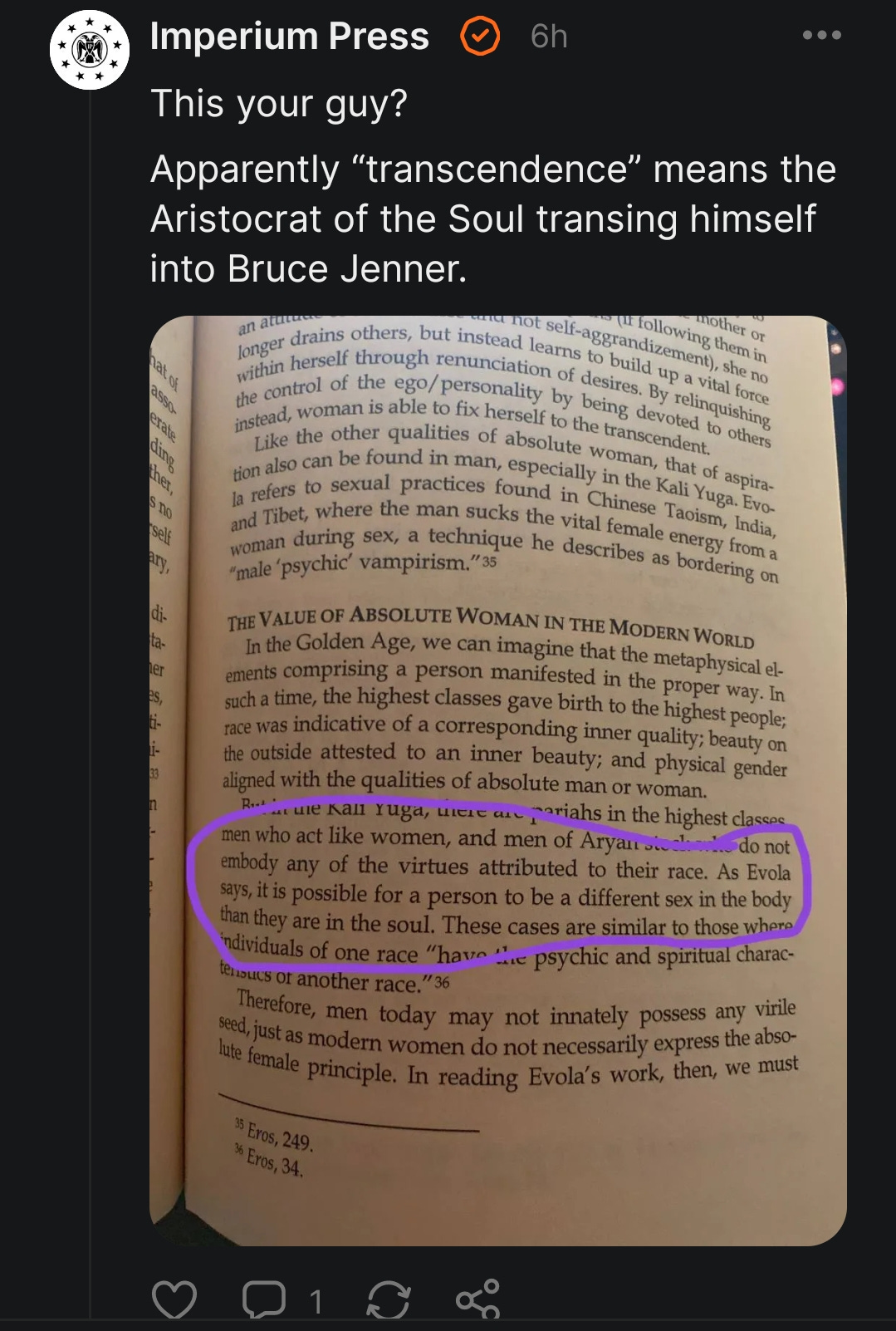
Imperium being one such trannie.
Seriously, go subscribe to Gothic.
And for continuing religious debate, subscribe to Axe at the Root:
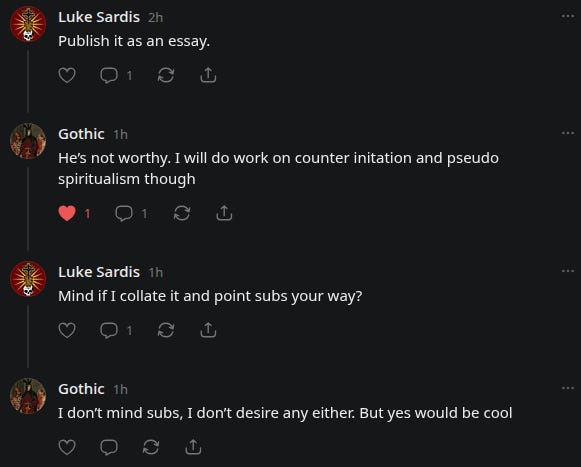
Permission:
Christianity is at the root of the evil that has corrupted the West. This is the truth, and it does not admit uncertainty. In its frenetic subversion of every hierarchy, in its exaltation of the weak, the disinherited, those without lineage and without tradition; in its call to “love”, to “believe”, and to yield; in its rancor toward everything that is force, self-sufficiency, knowledge, and aristocracy; in its intolerant and proselytising fanaticism, Christianity poisoned the greatness of the Roman Empire. Enemy of itself and of the world, this dark and barbarous wave remains the principal cause of the West’s decline.
-EVOLA
This was epic!!!!